
The Existential Cycle
How we lose and rebuild meaning

Have you ever felt uncertain about the world? Wondered about the meaning of the universe and your life within it?
This was the focus of the philosophical movement called Existentialism. It sought to explore how we interpret the world and how we find meaning in it.
I have personally enjoyed the ideas of the existentialists, but the insights are often buried in dense emotional texts. Nietzsche, Sartre, Camus, Kierkegaard, and others all had impactful insights about how to live in the world but were locked behind generally dense writing and abstraction. The ideas were mixed in with their personal afflictions, individual contempts, and used a lot of emotionally charged language to discuss it all.
But after studying their works, I found what seems to be a recurring pattern underneath them all. All of their arguments follow a general underlying path. They were too steeped in it at the time, but it’s clearer if you zoom out a bit.
I call it the Existential Cycle. It consists of four phases: Conformity, Collapse, Confrontation, and Creation.
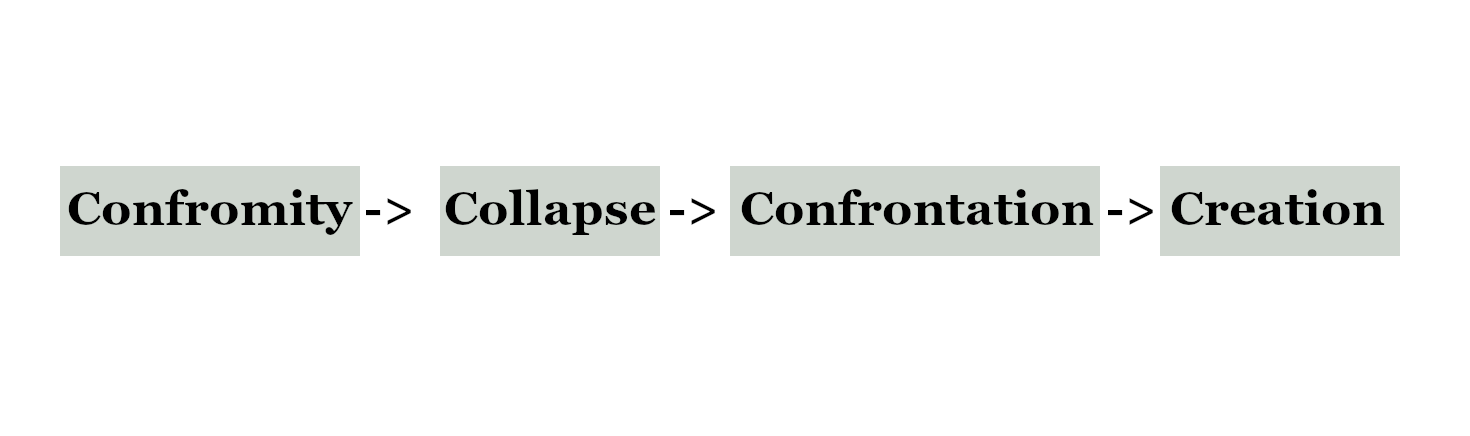
This is a universal pattern of human understanding, a pattern that every human can go through. If you go back through the existentialist philosophers you should be able to peg their ideas to these phases. Much of their works can be mapped in the cycle.
I find that having this cycle known can be very valuable, and can explain a lot about our world today. In a world where we have great freedom, the insights of a philosophy specifically about how to navigate the terrifying freedom of life can be especially useful.
I find it so valuable I’ll give you the one paragraph version here at the top before I explain more below:
The Existential Cycle is about how people lose and regain meaning in their lives. Conformity is our inherited meaning system from the culture we’re raised in. That meaning system is incomplete, contradicting information erodes your meaning and creates dissonance. Collapse is when the dissonance becomes unbearable and you no longer understand your place in the universe. Confrontation is when you decide to face up to not knowing your place. You start with Recognizing that your meaning has collapsed and why. You then Experiment with your understanding, try new beliefs and truths for yourself. Then you Discern what went right or wrong according to your true self. And once you’ve found the most correct path for you, you can live a life you’ve chosen for yourself in Creation.
Conformity
It’s natural to start at birth, because that is the ultimate beginning isn’t it? We are born into this world knowing nothing beyond our basic instincts. As we grow up we start to learn about the world and how it works. We learn from observing our families and communities, picking up little bits of information all the time.
The culture we grow up in ends up teaching us a lot, whether they directly tell you something or you just merely observe it. In our youth we pick up so much knowledge about the world around us that we don’t even know we’re gaining. Everyday is either learning new information or re-enforcing already learned lessons; about what to do, how to make meaning, what you’re meant to do, how to be a good person, and how to live your life.
This set of information you get in your youth and upbringing I call Conformity. It is the stage where you get your beliefs and understanding about the world from the culture you grew up in. Culture doesn’t even need to mean ethnic or nationality, but the practices and beliefs of people around you.
I call this your inherited beliefs, it’s how the world told you to make sense of things. You were thrown into the world with no information other than your body knowing how to breathe and eat. Everything else gets taught to you without you choosing. You inherit these beliefs because you’re not old enough to make choices on your own, and at this point you know so little most folks have little reason to question what they’re told. Life seems certain.
In these beliefs you come to absorb a meaning in life, how you make sense of yourself in the world. Since meaning is one of the bedrock concepts of this work and many coming works, here’s my definition of what I believe we’re saying when life has meaning:
Meaning is the felt sense that your life belongs to a coherent story shaped by the responsibilities and obligations you carry, whether inherited or chosen, and by the people and values that matter to you, in a way that lets you feel connected to something larger than yourself.
Growing up you probably absorbed a lot of information about your meaning, or what your culture says about your meaning. You have the values, responsibilities, and obligations that you have to the world. It tells you how to make sense of information, and often gives you an understanding of how you fit into the bigger world. Since we’re social creatures, it makes sense that we need understanding of what we need to do and what purpose it serves.
So far I’ve expressed this all as what we learn in childhood, but conformity isn’t confined to just childhood. It’s where we learn the bulk of how to live life and is supposed to prepare us for the rest of our lives.
Most people for all of human history seemingly lived their lives in conformity. I don’t believe conformity is a bad thing, it shouldn’t be shamed. If someone believes they are able to make sense of the world from the meaning system they got at birth then I think it’s mostly fine for them to keep it, as long as it doesn’t negatively impact others.
Here’s another definition, meaning system:
A meaning system is the framework of beliefs and narratives that tells you who you are, what matters, and how your life fits into a larger story.
The meaning system is how you process your understanding of your meaning in the world. Whether consciously or vaguely felt you are always interpreting your meaning through your meaning system. Under the conditions of most of the history of humanity, it provided a strong felt certainty in your meaning in life. But what starts to creep in is uncertainty, dissonance, and erosion of that meaning.
Collapse
Like said earlier, for most humans their inherited meaning system seemingly gave them adequate meaning for the entirety of their lives. Most humans who have ever lived likely died with their inherited meaning system.
Yet, as we live we see information that challenges that inherited meaning system. It’s a familiar phenomenon to feel like you learned something earlier in childhood and then later in life learn it’s likely the exact opposite. We first learn from myths and simplifications, and then learn the facts and the specifics.
As we learn more, as we encounter more uncertainty, we experience dissonance. Dissonance is the feeling that new information doesn’t fit with your meaning system, that it shouldn’t be happening. It’s when you have uncertainty in how you make meaning when before you were stable.
So if you have a belief along the lines of “there is justice in the world” and you witness an extreme injustice, it creates dissonance. If you believe something like “the people in charge know what they’re doing” and then see glaring signs that the people in charge have no clue what they’re doing, you start to feel the dissonance.
Humans can take a lot of dissonance in their meaning systems, especially if they are very thick. But as time goes on, the more attuned to the world you are, the more you learn, the more the dissonance can pile up. It can be very uncomfortable when your meaning system does very little to make sense of the world. You have ways to interpret the world that should make sense, but the more you see the less sense it makes.
In the conformity stage you can accumulate a lot of dissonance and feel bad. But many are able to keep going. You accumulate uncertainty until you just can’t anymore, you hit a breaking point. This is the collapse.
Collapse is when you no longer understand your place in the universe.
Your meaning system is supposed to be how you make sense of events and determine how you matter in the world. We humans need this understanding, we need to have some sort of certainty about the world and where we fit in. But if we encounter enough evidence against that system, we can just collapse.
The collapse has many different names that all outline the same basic phenomenon. Existential Crisis, Midlife Crisis, Quarterlife Crisis, these are all collapses in meaning systems. The shared experience is no longer having answers ready for what life means, your purpose, your narrative.
In collapse there are often dark parts. The deeper someone falls, the more prone to depression and anxiety they are. Humans feel the need to somewhat coherently understand the world, to have meaning. But as we learn more, the less likely our inherited meaning system will likely be able to coherently understand.
Collapse in its stronger forms is synonymous with driftlessness, it’s dizzying, disorienting. If you don’t know your meaning in the world, what are you supposed to do? Some call it the void. Some call it nihilism. Existentialist philosopher Albert Camus called it The Absurd.
Common feelings in the collapse are along the lines of “Nothing Means Anything”, “life is pointless”, “I’m meaningless”, “the world is fake and a sham”, “why do anything if it doesn’t mean anything?”.
While people can have milder or deeper collapse, the same basic feeling of uncertainty is felt. When you used to feel certain about your place in the world, you are now uncertain. That uncertainty has consumed countless lives in history.
Many people avoid interfacing with uncertainty because we can intuitively understand how bad a collapse is. If you let some uncertainty in, where does it end? Once collapsed, how do you make it through? Where do I end and the world begins?
Confrontation
After you’ve collapsed it can feel very bleak. The whole world is uncertain. Sure you might still live your day to day life, but it has so little meaning. You don’t know why you do what you do, other than that it’s what you’ve done before. Sure there might be some practical reasons, like having to earn enough to pay rent and buy food, but even that seems pointless and made up.
There are many people who experience the collapse of their meaning systems and it’s possible to never recover. If you stay in the collapse it’s called nihilism. If you truly feel this collapse and no way through it, there are many who have lost their lives to the collapse.
But there is a way, you don’t have to stay in the collapse. You can move forward from it. This is the crucial turn in existential philosophy, that after the collapse can come confrontation.
Confrontation is when you decide to face up to the uncertainty of the world and attempt to find meaning anyway.
The two important words in that definition are “decide” and “anyway”.
Collapses in of themselves are involuntary. Even if you willingly seek out the uncertainty of the world, you don’t choose to go into collapse. At least from my conception, collapse happens when you unconsciously no longer can make sense of the world, it’s not in your control. Many people try hard to hold onto their inherited meaning systems for so long, but eventually they succumb to the uncertainty.
Yet, while the collapse is involuntary you have to deliberately do the confrontation. You have to decide to face up to the world. And not just face up to the world, you have to face up to the uncertainty. If you reject the uncertainty of the world, then you aren’t really doing confrontation. We’d call that avoidance, which I’ll elaborate on later.
You have to accept the uncertainty, or at least the uncertainty caused by your previous meaning system. This is the “anyway” from earlier. You have to willingly decide to rebuild your meaning that incorporates the meaningless uncertainty of the universe.
There are three sub-phases of confrontation. Reckoning, Experimentation, and Discernment.
Reckoning
From the bottom of the collapse is the initial stage of rebuilding. Reckoning is about facing what is real. You have to actually accept the uncertainty of the world, and accept the responsibility of figuring out your meaning.
This stage has a high cost that many don’t accept, because we can intuit that it’s a lot of work, AND IT IS. The process of rebuilding your meaning system from the bottom of the collapse is a tall task. There is so much to mull over and rectify.
You also need to start the process of figuring out what really matters to you, what in the world you care about. It can be the people in your life, some facet of the world you enjoy, or even just the possibility of a better future. Without something you care about in this world, you’ll have little reason to actually work through the confrontation.
But like the famous saying goes, a journey of a thousand miles starts with a single step. The first step is deciding to rebuild your meaning system in a way that incorporates the uncertainties you had absorbed. You take on the task of trying to build harmony from the dissonance. To find some form of meaning and certainty when your belief in either had been shattered.
Experimentation
After you’ve decided to start the confrontation, the body of the work is experimentation. You’ll likely have to start playing with values and what has any sort of meaning to you. Again this is about how you find meaning in this world, not somebody else’s meaning.
While you might have your base values that make it worth living, you’ll likely need more than just one thing to live for. You play around with what values are actually yours, what you really believe deep down. You try experimenting with thoughts but also expressions of yourself. You might test new ways of acting, being, dressing, socializing, new religions, different philosophies, trying new things; all testing to see if something resonates for you.
Experimentation is hard and both unrewarding when it doesn’t work, yet deeply rewarding when it does. It’s in a way “finding” yourself. But it’s not some prescribed way of being that you find for yourself, like you’re never going to find a book that tells you who you are. But you can find ways of thinking, ways of understanding your meaning in the world that resonate better with you.
And a fact is that some people have pretty strong feelings about who they are so only need a little bit of experimentation. While others have relatively weak understandings and tepid feelings about who they are so they end up needing lots of experimentation. It’s different for everyone, not everyone just innately knows who they are.
Discernment
This is where you look back at your experiments and try to understand what was true to you, and what was just merely interesting. I have a constant problem where I have to really think about something, whether I actually like it or if I want to be a person who likes it. Those are two separate things. Do I actually like whiskey (no) or do I want to be someone who likes whiskey (yes)? Discernment is about finding what you actually are, and not what you’d merely like to be.
This takes a lot of introspection. You’ll likely oscillate between experimentation and discernment a lot in this phase. All of life is trial and error, and this is a point when it’s very explicit. Some people only need to run a few experiments and find what’s real for them, others spend a whole lifetime trying. It’s hard work that involves being very honest with yourself. You cannot truly discern if you aren’t frank about the facts, the truths you’ve uncovered, and your real genuine feelings.
Successfully working through confrontation requires a brutal honesty that most of us aren’t willing to give. I personally happen to have a weird temperament where I’m very willing to do confrontation, I like finding the truest truths and know I have to do confrontation to get there. But it’s taxing, and requires knowing yourself at a very deep level. It’s tough work, but it’s worth it for what can come.
You also need to be able to create a boundary between where you end and the world begins. There are infinite meaningful causes in the world but only a finite you within a finite life that will end. Without boundaries you may try to give more than you have and be upset that you couldn’t give more. Figuring out your values may expose a lot of areas of meaningful work, yet there is still only the efforts you can actually do and not what you wish you can do.
Creation
After you’ve done adequate confrontation, you’ve discerned what’s real and have a sense of meaning again. You have rebuilt your meaning that accounts for the meaninglessness of the world. You have done the work to discover who you really are and how you understand yourself to be meaningful to yourself.
Creation is the final stage in this cycle, where you get to use your new knowledge of who you are and create the life you want to live. Not just surviving, not living by default, but a life you create for yourself.
This can be comparable to self-actualization or as Nietzsche would call it the Übermensch. It means living a life that you fully choose, not just the life with the meaning system you inherited. It can be self-authored or it can mean choosing a defined way of life, regardless of which the importance is that you choose and you feel it’s correct for you.
But there can be smaller versions of this too. If your collapse was just in one part of your beliefs it could just mean you have reached stability. It’s a stage where you’re able to take the freedom you realize you have, with all that uncertainty in the world, and move forward with greater certainty of your meaning. You have rebuilt your meaning system to be both stable and useful. You’re able to see your place in the world, find meaning, and incorporate new information in this system.
It’s a very difficult task to reach creation, but it is possible. I feel like I’ve reached creation in some domains while still in confrontation about others. If you reach it it’s quite rewarding. All the pain of the past seems quite distant and feels worth it, because building a coherent stable meaning system based on your values makes the world and your life make a lot more sense.
You might even find yourself back to the exact same values you had before, which is the funny part. You could go through and find that your inherited values are indeed your true values. But this is still better, because you have certainty they are your values now and not ones you just passively absorbed.
Even after reaching creation it can be fragile, there’s still the possibility of getting plunged back to collapse. While creation incorporates uncertainty it doesn’t resolve it.
But with the high cost, there’s a way people often avoid taking on this task. I don’t really fault them, but it does exist and is worth discussing.
Avoidance and Reaction
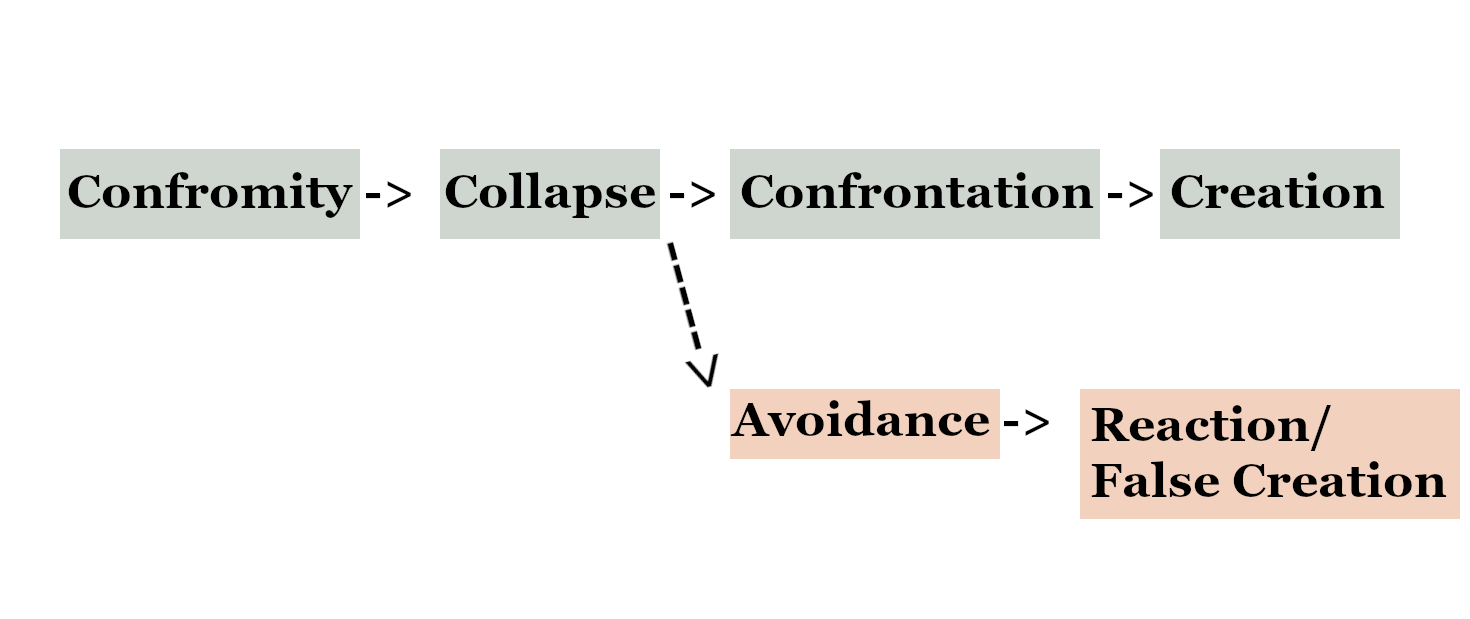
Let’s say you’re in a state of collapse feeling some of the worst mental disorientation of your life. You’re fighting for your life and trying to just grasp at something.
At this stage it’s very easy to avoid confrontation because the work is very difficult. You might feel a strong attachment to your former self, when things were certain. If you enjoyed your life in conformity you’re likely not going to choose to become someone else.
There are those who avoid the work of confrontation and reach for easier explanations. Especially when collapse comes from humiliation they’ll have little desire to incorporate what made them feel foolish. In this they’ll turn to reaction, hating what made them collapse.
Your beliefs in reaction tend to be of two flavors, either wanting to return to conformity or to move towards a false creation. If you particularly liked your life in conformity, you’ll likely yearn to go back. From a psychological point of view, it makes sense. If things were good, you want to go back to when it was good.
The False Creation is a different story, but one that rhymes. Instead of merely returning, it’s about creating a world where your inherited beliefs aren’t just neutrally okay, but that they are the most good. It’s a fantasy world where you won’t just have meaning, but will have massive amounts of meaning. It’s a world where you reject that there’s uncertainty, that there was actually a hidden truth all along and should have a world built on that hidden truth.
This reactionary world builds on the rejection of some sort of truth that caused uncertainty. Whether it’s scientific, psychological, economic, political, racial, virtues, or anything else. There had to be some truths that seem just too painful to confront, so the confrontation is avoided and a false creation takes hold. It’s a powerful force that seems to be quite available today.
The avoidance and reaction lineage is consistent with Sartre’s bad faith, Nietzsche’s ressentiment, and others from the canon. Unprocessed existential anxiety is experienced as external threat. When the anxiety from meaning collapse is avoided it becomes reaction.
Working your way through the cycle
The cycle itself is quite a task to complete. It’s not even certain if the existentialist philosophers themselves made it to creation, they seem to have been more the explorers of what was a new phenomenon than the experts at working through it.
My hope is that by making the cycle clearer, we will be better able to diagnose a lot of what is happening in the world today. I believe working through the cycle is important work that someone should take responsibility for if they experience collapse. While the collapse happens to us involuntarily, what we do with it is firmly in our hands.
But even knowing the cycle, not everyone’s circumstances make it possible to fully move to creation. Knowing the cycle doesn’t guarantee creation, but knowing it exists sure helps. Even if you reach creation it’s a stage, not an endpoint. The work of facing the absurd is never finished as long as you live, but I believe it’s worth it.
I think this has broader implications as well. I will be using this Existential Cycle as a load-bearing concept for later works. To tease, I believe that a growing amount of the world is in a soft-collapse of meaning, and it explains much of the weirdness of our time. People are grasping for meaning in their world for freedom. I hope that first naming the cycle and making it apparent without having to digest hours upon hours of existentialist philosophy helps.